
Your Average Performers Are Costing You Millions
Jun 18, 2026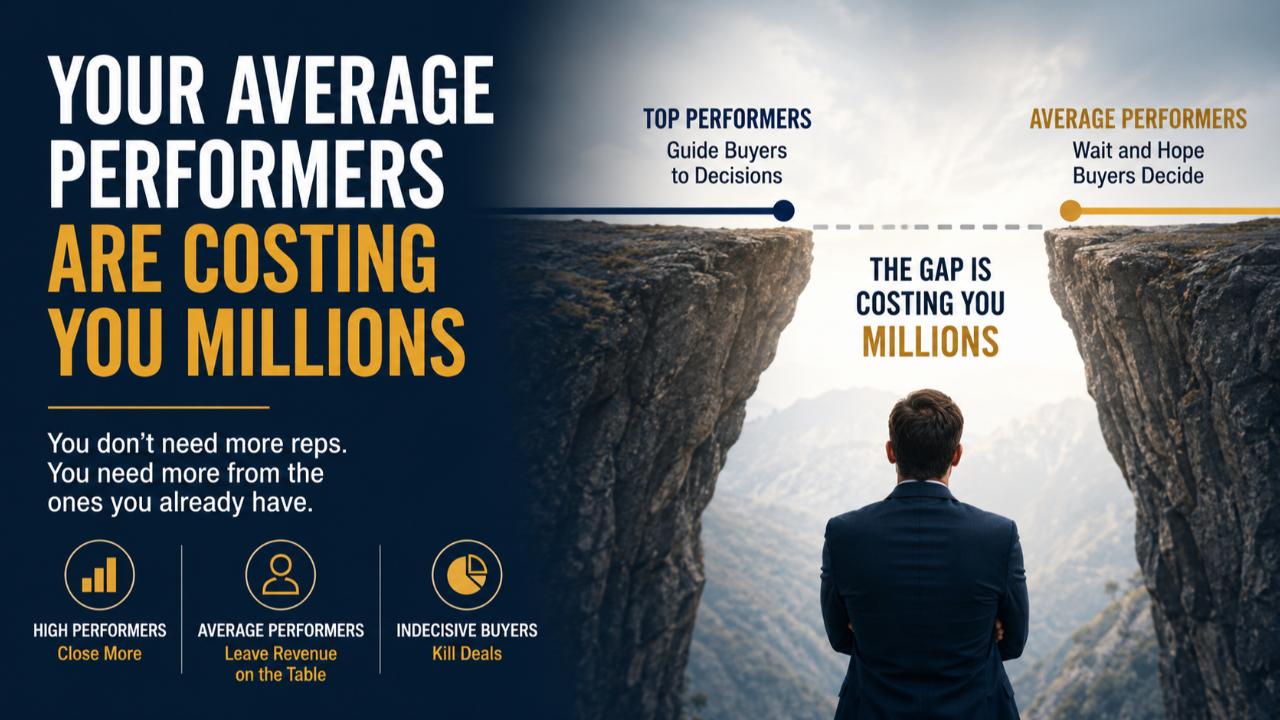
You don't need more reps. You need more from the ones you already have.
Most sales leaders spend their energy on the wrong people.
You coach the bottom 10 percent toward the door. You celebrate the top 20 percent who would win with or without you. And the middle 70 percent gets a quick check-in and a "keep it up."
That middle is where your money is.
These are not your problem people. They show up. They work. They land somewhere between fine and good. And every one of them is sitting on revenue they are fully capable of producing and currently are not.
The Gap Is Not Effort
The difference between an average performer and a top performer is rarely effort. Your average reps are often working just as hard as your best ones. The gap is close rate and deal velocity.
- Top performers close 50 to 60 percent of qualified opportunities
- Average performers close 20 to 30 percent
- Bottom performers close 10 to 15 percent, if that
Same pipeline. Same leads. Very different outcomes.
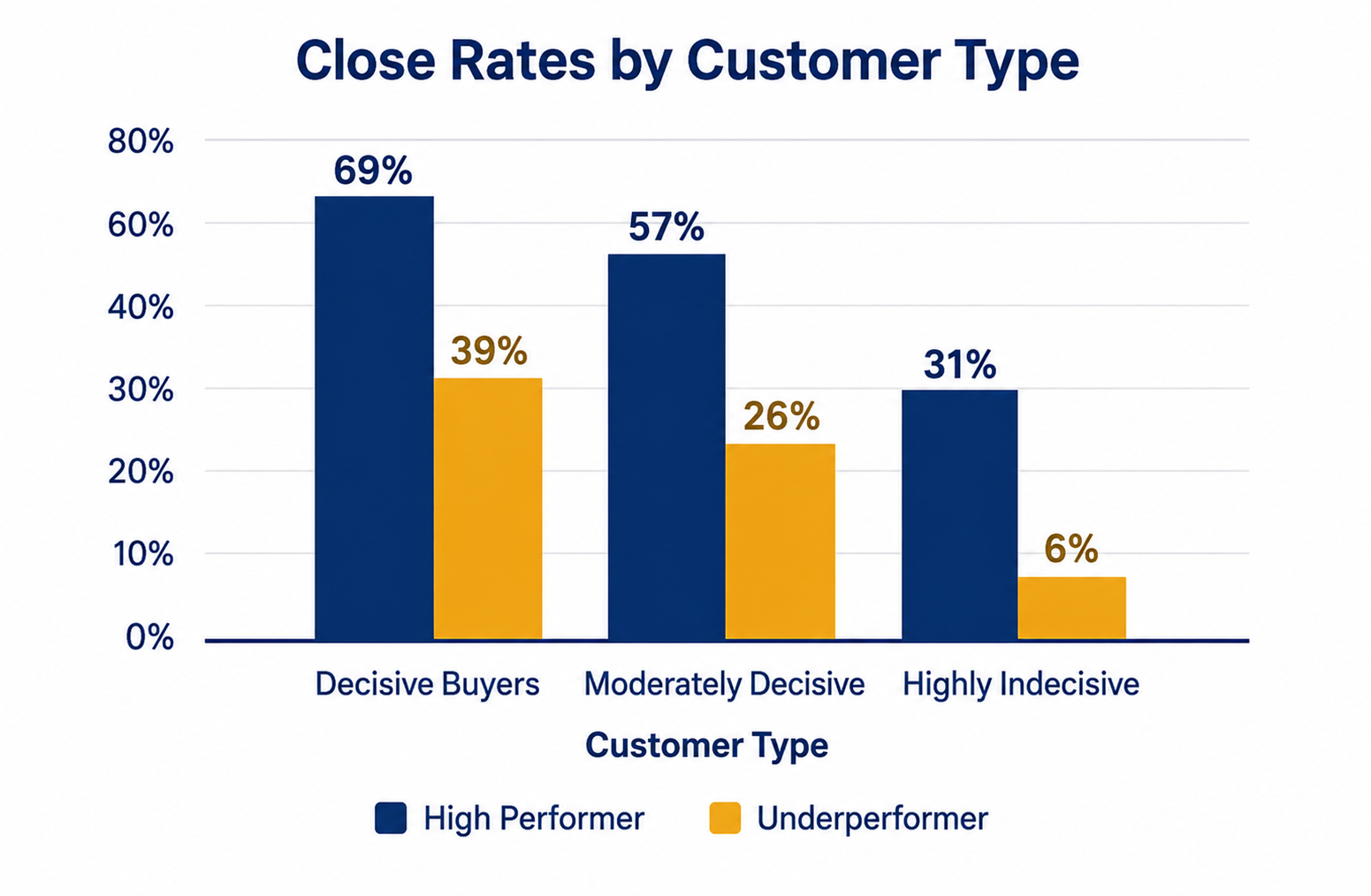
Look at what happens with the hardest buyers. Against a decisive buyer, the gap between your high performer and your average one is real but survivable. Against a highly indecisive buyer, the high performer still closes 31 percent. The average performer closes 6 percent.
That is not a small difference in talent. That is the difference between guiding a stuck buyer to a decision and waiting politely while they "think about it."
And indecisive buyers are not the exception. They are where most of your revenue actually lives or dies. The majority of lost deals are not lost to a competitor. They are lost to "no decision," to a buyer who wanted to change but never got across the gap between wanting it and committing to it. Your top performers know how to walk a buyer across that gap. Your average performers wait for the buyer to cross it alone, and most never do.
That one capability, the ability to move a buyer through indecision, is the widest line between average and elite. Everything else is a rounding error next to it.
The Hidden Cost
Every average rep who stays average leaves somewhere between $200K and $500K a year on the table.
Multiply that across your team, and you are not looking at a coaching problem. You are looking at millions in recoverable revenue. It never shows up in a report, because you never lost it on paper. You just never earned it.
The question is not whether you can afford to raise your average performers. It is whether you can afford to keep funding that gap, quarter after quarter, while you wait for the next hire to fix it.
Put your own pipeline into this calculator. It shows what a top performer would close on it, what an average performer would close, and the size of the pipeline your average rep would need just to match the top performer without adding a single hire.
That last number is the one that should stop you. For an average rep to match a high performer on close rate alone, they would need to roughly double their pipeline. That is not happening. You cannot hand a rep twice the leads, twice the meetings, and twice the hours and call it a plan. The pipeline is not the lever.
Capacity is. Raise what a rep can do with the pipeline they already have, and they close more without working more. That is the play.
Why Average Performers Stay Average
Here is the part most writing on this topic skips.
It is easy to name the problem. Far fewer people tell you it is fixable.
It is.
Average performers are not stuck because they lack drive. They are stuck because they are missing two capabilities that top performers use without thinking about it:
- They don't catch the story they are telling themselves. The quiet assumption that this deal probably won't close, that this buyer isn't serious, that the price is too high. Those beliefs show up in a rep's behavior long before they show up in the forecast.
- They don't know how to guide a buyer through indecision. So good deals stall at 70 percent and die to "no decision" while the rep waits for a callback that never comes.
Top performers do both on instinct. Average performers can learn both. That is the whole opportunity, and it does not require a single new headcount.
The Good News: This Can Be Done
Raising a rep's capacity comes down to two things. Give them more time to sell, and raise their skill while they sell. Here is what that actually looks like.
Give them their time back. The administrative load is real, and it is quietly eating selling days. There is now technology that sits on top of your existing CRM and uses AI agents to handle much of the manual work, the updates, the logging, the follow-up prep. The result is roughly a full day a week back, per rep, spent selling instead of typing. The bonus: your CRM data finally becomes accurate, which makes your coaching and your forecasting honest.
Run a one-on-one that actually changes performance. Not a status update. A real conversation that surfaces the bad assumption a rep is carrying, and holds them accountable to the commitment they made to themselves that week.
Use your team meeting to build, not just report. Work a stalled deal together as a group. Let the team teach the team. Skill and confidence rise across everyone in the room, not just the one rep with the deal.
Time, belief, and skill. The capacity is already sitting inside your team. Most leaders have simply never been shown how to release it.
You Just Saw a Number. Now Let's Find the Real One.
The calculator gave you an estimate. It is directional, and it is almost certainly conservative.
Your real number is specific to your team, your pipeline, your buyers, and the distance between your average reps and your best ones. In my experience, it is bigger than the leader expected, every time.
That is the conversation worth having. Not a pitch. A diagnostic. I will help you see the actual cost hiding in your team, where it is leaking, and what it would take to recover it. Then you decide what to do with what you see.
Find your exact number by clicking the Schedule Your Diagnostic button below.
Most sales leaders know something's off but can't pinpoint what's keeping their team stuck. Our Sales Performance Diagnostic shows you exactly where underperformance is rooted, where deals stall, and what's costing you revenue right now. No fluff. Just clarity on what to fix first.
