Zero Percent
Jun 04, 2026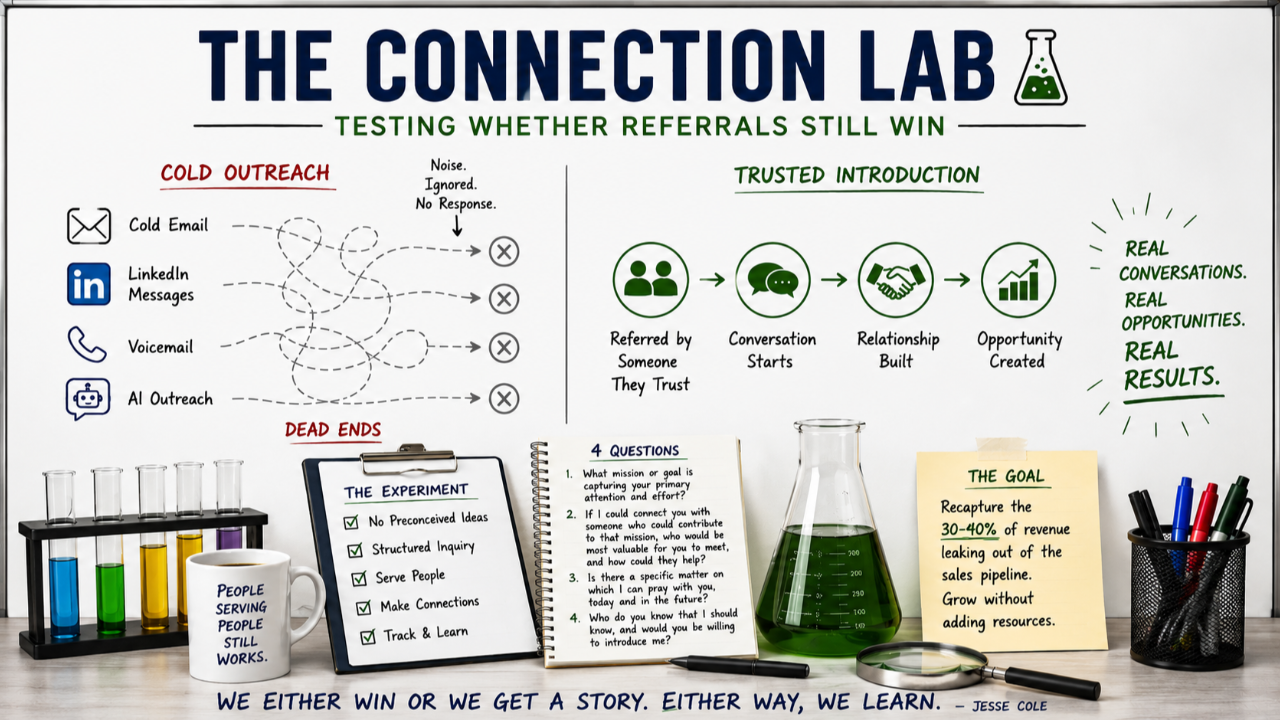
I recently had a conversation with a CIO of a billion-dollar organization. I asked him, what are the statistical odds that a sales rep will receive a response from you when reaching out cold? His response was quick and sharp. Zero percent, he said. Then he talked about all the noise, the email, the LinkedIn messages, the voicemail, and how with all that noise he simply does not respond to any of it.
So I asked, how do people reach you then? Because I know you're making buying decisions on software and technology. He said that's easy, and he gave me three ways.
- They are referred to him by someone he trusts.
- They are referred by a peer who does similar work.
- They happen to meet at a small conference where they're there for a shared purpose.
Many sales professionals have been trained to measure activity metrics, and many are managed on those metrics as well. The idea is that enough quantity will eventually be rewarded. The problem is that we have created a noisy world, and many economic buyers have put their noise-canceling headphones on. So few, if any, of our connection attempts get through. That leaves sales professionals with one of two options.
- Keep doing the ineffective reach outs.
- Change the methodology and become more effective.
This CIO's answer confirmed what I've been thinking for a while. In the world of AI technology where we can create agents to do the hard work of cold reach out, we have created an environment that rewards the old-school way of selling, focusing on the referral. Referrals have never lost their impact. They remain the most effective sales opportunities we have in our pipelines, and the research has said so for years.
And yet, even though we see the stats, I believe many professionals are uncomfortable leaning on this strategy to grow a business. It feels too slow. And as simple as it seems in concept, many struggle with how to actually use referrals as a growth strategy. At some level it's a fear that we might be rejected when we ask for the referral, or that someone we care about might feel we're using the relationship for our own gain.
I've had what most would consider a very successful sales career in the B2B space over the last twenty-five years. Even I admit that little of my success leaned on the referral strategy. I now wonder how much more successful I could have been. A Dale Carnegie study found that ninety-one percent of customers are willing to give a referral, yet only eleven percent of salespeople ever ask.
So here I am at a crossroads in my career. Based on my years of experience and study of human behavior, mostly to improve my own performance, I came upon a system that recaptures the thirty to forty percent of revenue currently leaking out of an organization's sales pipeline. I'm not sure whether it happens because leaders do not see it, or because they don't know what to do about it. Either way, I found the consistent leak, and I have a system that, when installed, recaptures a significant portion of it. It's a way for a business to grow revenue without adding resources.
When I get the chance to show people, they're often intrigued. And then they say, Scott, I didn't know you were doing this, or, I really didn't understand what you were doing before this conversation. That is my fault. I don't put myself out there enough to share it, and I need to resolve that and help more companies in the process.
So I am creating what I call the Connection Lab.
This is a way for me to test my theory that referral connections are the most effective way to build awareness and a business. Jesse Cole, the owner of the Savannah Bananas, talks about experimentation. He loves it, because it often leads to failure, and failure is usually where we find what's right. He reframes it this way: we either win or we get a story. Personally, I love both.
Here are the rules of the Connection Lab experiment.
No preconceived ideas. I'm stepping into this with an open heart. Judging someone before meeting them is out of the question. I cannot assume they don't know someone I should meet. We never know what connection hub a person may be part of.
Structured inquiry. When I meet with someone, I'll ask four questions. The first three aim to genuinely connect with the person. The final question points toward the essence of the experiment.
- What mission or goal is currently capturing your primary attention and effort?
- If I could connect you with someone who could contribute to that mission, who would be most valuable for you to meet, and how could they help?
- Is there a specific matter on which I can pray with you, today and in the future?
- Who do you know that I should know, and would you be willing to introduce me?
Who I'm looking to meet. I'm primarily seeking introductions to leaders responsible for driving the revenue growth of their company. The ideal company is midsize and has at least one sales team of roughly six to twelve players. My experience lets me excel with B2B sales teams. I'm also interested in connecting with the leadership of industry associations. I'd love to use my speaking gifts to bring value to other sales leaders in a shared environment.
How it works. These are structured conversations lasting twenty to thirty minutes, by phone, Zoom, Teams, or in person. Short, but impactful by design.
A few ground rules to keep it clean. In-person meetings stay casual and modest, with no meals or drinks involved. I won't offer or accept affiliate commissions for an introduction, and I won't pay into groups that exist only to network. These connections need to be about mutual interest, not anything transactional. I want to prove that people serving people still works.
Will this experiment work? Will my theory be proven correct? I don't know. What I do know is that I've played around with this passion of mine for several years and made some side money here and there. But for all intents and purposes, I'm starting this experiment at zero when it comes to my business.
So here's my ask.
If you lead revenue growth for a midsize company with a B2B sales team, let's have one of those conversations. Twenty to thirty minutes, no pitch, no cost. Reach out by email with a subject line of "The Connection Lab" and let me know you're in on this experiment.
If you know someone who fits what I described, an introduction is the most valuable thing you could give me. Please send it my way using the same email and subject line above.
And if you simply want to watch the experiment unfold, follow along. I plan to share openly, here and on LinkedIn: the failures, the stories, and the wins. My hope is that others get to learn right alongside me.
Most sales leaders know something's off but can't pinpoint what's keeping their team stuck. Our Sales Performance Diagnostic shows you exactly where underperformance is rooted, where deals stall, and what's costing you revenue right now. No fluff. Just clarity on what to fix first.
